Embarking on the journey of amateur astronomy is one of the most rewarding pursuits in science. However, standing under the dark night sky with the wrong instrument can quickly lead to frustration. Choosing the right first telescope requires understanding how aperture, focal length, and optical glass elements work together to collect ancient photons from distant celestial bodies.
Every telescope functions primarily as a light bucket. Contrary to popular misconception, magnification is not the defining metric of an astronomical instrument—aperture is. The primary objective lens or parabolic mirror gathers faint incoming light and concentrates it into an intense focal point, allowing human eyes or camera sensors to reveal structures invisible to the naked eye.
When entering the hobby, amateur observers encounter three fundamental optical architectures: Refractors (dioptric systems using glass lenses), Reflectors (catoptric systems using polished curved mirrors), and Compound/Catadioptric instruments (hybrid systems blending lenses and mirrors). Each design features distinct physical tradeoffs regarding optical aberrations, portability, maintenance, and thermal equilibration.
The best telescope is not the largest one in the catalog, but the one you actually carry outside under clear skies. Balance optical aperture against ease of setup, overall weight, and mounting stability.
The Three Core Optical Architectures Compared
Refractor Telescopes
Mechanism: Objective glass lens at the front bends light into an eyepiece at the rear.
Best For: Lunar craters, planetary surfaces, double stars, zero maintenance.
Newtonian Reflectors
Mechanism: Primary parabolic mirror at base bounces light to an angled flat secondary mirror.
Best For: Maximum aperture per dollar, deep-sky nebulae, galaxies, faint star clusters.
Compound (SCT / Mak)
Mechanism: Front corrector lens combines with spherical primary and secondary mirrors to fold light.
Best For: Ultra-compact portability, long focal length, planetary astrophotography.
1. Refractor Telescopes: Razor-Sharp Contrast
Refractors represent the historic lineage of Hans Lippershey and Galileo Galilei. Modern refractors are divided into Achromats and Apochromats (APO). An achromatic refractor utilizes two bonded glass elements (crown and flint glass) to bring two wavelengths of light (typically red and blue) to a common focus. While economical, achromats display chromatic aberration—a faint purple halo encircling bright objects like Jupiter and the Moon.
Apochromatic refractors, often incorporating extra-low dispersion (ED) or fluorite synthetic glass, utilize triplet or quadruplet designs that bring three wavelengths into precise convergence, eliminating false color completely. Their closed optical tube keeps internal mirrors free from dust and moisture, making them extremely durable and alignment-free.
2. Newtonian Reflectors & Dobsonian Value
Invented by Sir Isaac Newton to overcome the chromatic fringing of simple lenses, Newtonian reflectors replace expensive front lenses with a single curved glass mirror coated with vacuum-deposited aluminum and protective silicon dioxide. Because mirrors reflect all wavelengths of light at identical angles, Newtonian reflectors are inherently immune to chromatic aberration.
When mounted on a simple lazy-susan alt-azimuth wooden base, this optical tube assembly (OTA) is celebrated worldwide as a Dobsonian telescope. For the cost of a modest 80mm refractor, an amateur can purchase an 8-inch (203mm) Dobsonian reflector. That 8-inch mirror gathers over four times more light than a 100mm lens, transforming faint, shapeless smudges of deep-space galaxies into distinct spiral structures and resolving thousands of individual stars within globular clusters.
3. Compound Telescopes: Schmidt-Cassegrain & Maksutov-Cassegrain
If trunk space is limited or high magnification of planetary details is your primary objective, Catadioptric designs fold light back and forth across a short optical tube. A 2000mm focal length instrument can easily measure less than 20 inches in total length.
Schmidt-Cassegrains (SCT) use a thin aspheric corrector plate at the aperture, while Maksutov-Cassegrains (Mak) feature a deeply curved meniscus corrector lens with an aluminized secondary spot. Maksutovs deliver extraordinary planetary sharpness comparable to fine refractors, though their thick meniscus lens requires more time to acclimate to ambient nighttime temperatures.
| Optical Design | Typical Aperture | Optical Maintenance | Portability | Best Observation Target |
|---|---|---|---|---|
| Achromatic Refractor | 70mm – 102mm | Zero (Sealed Tube) | High | Moon, Planets, Double Stars |
| Dobsonian Reflector | 150mm – 300mm | Periodic Collimation | Moderate (Bulky Tube) | Faint Nebulae, Galaxies, Messier Catalog |
| Maksutov-Cassegrain | 90mm – 127mm | Very Low | Very High (Compact) | Jupiter Cloud Belts, Saturnian Rings |
| Schmidt-Cassegrain (SCT) | 150mm – 280mm | Occasional Secondary Collimation | High for Aperture | Versatile All-Around & Astrophotography |
Aperture vs. Magnification: Calculating Real Limits
Department store telescopes often advertise deceptive claims such as “675x Magnification!” on colorful retail boxes. In reality, optical physics imposes a strict practical limit on useful magnification: approximately 50 times per inch of aperture (or 2x per millimeter) under exceptional atmospheric seeing conditions.
For a 70mm (2.75-inch) refractor, the realistic maximum useful magnification is roughly 140x. Pushing the instrument beyond this limit simply enlarges a dim, blurry, vibrating image without revealing additional detail. Focus instead on aperture, which dictates both your light-gathering power and theoretical resolving power via Dawes’ Limit: resolving limit in arcseconds equals 116 divided by aperture in millimeters.
Essential Beginner Checklist Before First Light
- Align Your Finderscope in Daylight: Point your main telescope at a distant radio tower or telephone pole, center the target, and adjust your finderscope or red-dot sight until both crosshairs perfectly match. Attempting this alignment in pitch darkness is an exercise in futility.
- Allow Thermal Acclimation: Mirrors and lenses expand and contract with temperature changes. Set your telescope outside 30 to 60 minutes prior to viewing so the optical elements equalize with ambient nighttime air.
- Start With Your Lowest Magnification Eyepiece: Always begin observing with your longest focal length eyepiece (e.g., 25mm or 32mm). This provides the widest field of view, making it easy to locate objects before swapping in a higher-power eyepiece.
- Preserve Night-Adapted Vision: It takes the human eye roughly 20 to 30 minutes to develop rhodopsin for dark adaptation. Use exclusively dim red flashlights; a single flash of white light resets dark adaptation instantly.
Frequently Asked Questions
Can I see Apollo lunar landing gear with an amateur telescope?
No. The Apollo lunar descent stages are less than 10 meters wide at a distance of 384,000 kilometers. Resolving an object that small from Earth would require an optical telescope mirror over 200 meters in diameter—larger than the biggest observatories ever conceived.
Will deep sky nebulae look colorful like Hubble or Webb photographs?
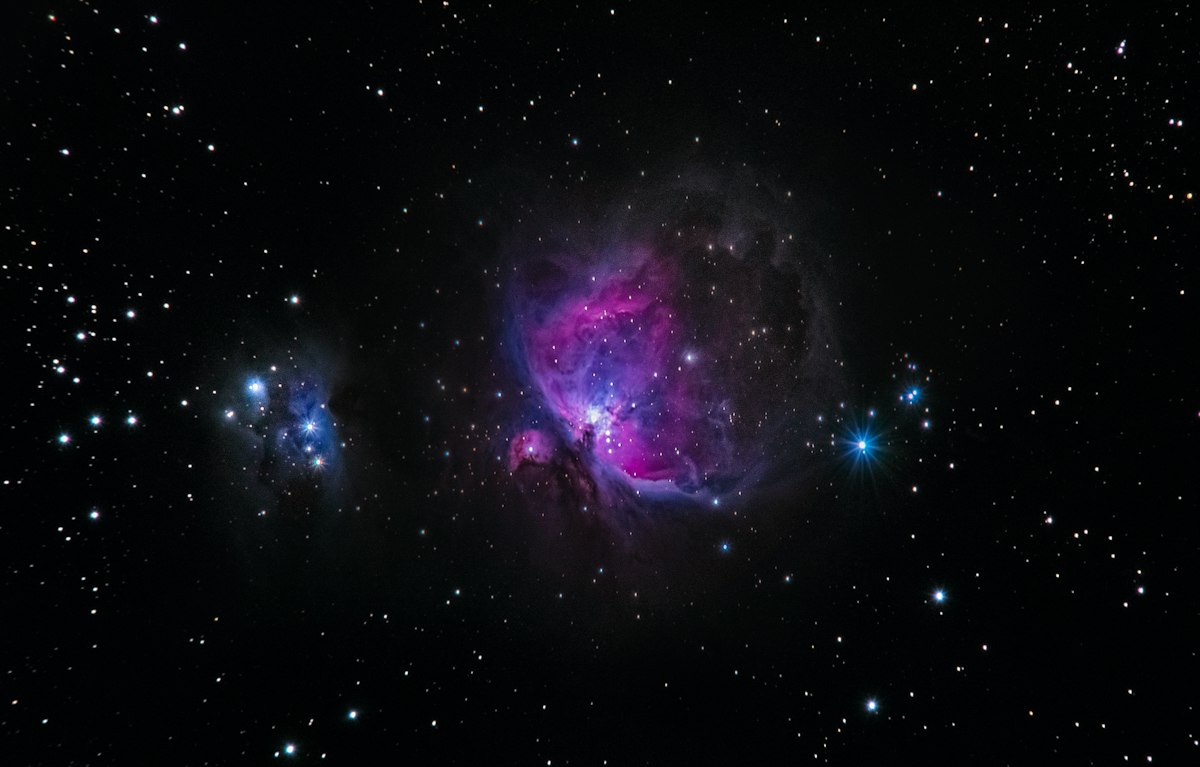
To human eyes through an eyepiece, faint nebulae appear in shades of luminous grey and soft green. This occurs because human retinal cones (which perceive color) require bright light, while dark-adapted rods (which perceive light intensity without color) handle dim deep-space photons. Long-exposure cameras, however, accumulate photons over time to reveal brilliant pinks, blues, and golds.
What is our definitive recommendation for a beginner’s budget?
A 6-inch or 8-inch Dobsonian reflector offers the best balance of aperture, stability, ease of use, and visual excitement for amateur astronomers beginning their celestial exploration.
6. Critical Beginner Mistakes to Avoid When Buying Your First Scope
Every year, thousands of aspiring stargazers make costly mistakes that result in their new telescope gathering dust in a closet after just two observing sessions. Understanding these common traps before spending your hard-earned money will save you countless hours of frustration:
- The “High Magnification” Advertising Trap: Department store telescopes frequently boast outrageous claims like “675x Magnification!” on the packaging. In optical physics, a telescope’s maximum useful magnification is strictly limited by aperture—roughly 50x per inch (2x per mm) of aperture under ideal atmospheric conditions. A cheap 60mm refractor attempting to magnify at 500x will produce only a hopelessly dim, blurry, un-focusable smear.
- Undersized, Shaky Tripods: An optically brilliant telescope tube is completely useless if mounted atop a wobbly aluminum tripod with loose plastic joints. High-magnification views amplify vibrations by hundreds of times; simply touching the focuser or experiencing a gentle breeze will cause the Moon or Saturn to dance wildly out of the field of view. Prioritize rock-solid wooden or heavy steel legs, or opt for a floor-mounted Dobsonian rocker box.
- Ignoring Thermal Equilibrium: Glass mirrors and thick doublet lenses expand and contract with temperature changes. Moving a telescope from a heated 21°C (70°F) living room directly into freezing outdoor winter night air creates turbulent thermal boundary layers inside the tube that ruin fine planetary resolution. Always allow your optical tube 30 to 60 minutes to cool down to outdoor ambient temperature before observing fine planetary detail.
- Improper Optical Cleaning: Never wipe dusty optical glass or aluminized mirrors with household paper towels, shirts, or standard glass cleaner sprays. Microscopic airborne quartz dust particles will scratch delicate multi-coatings and optical surfaces, causing permanent light scattering and loss of contrast.
7. Recommended Budget Allocation Strategy for Beginners
To maximize your investment and ensure years of rewarding visual astronomy, allocate your starting budget according to this proven field-tested framework:
| Budget Tier | Recommended Telescope System | Key Capabilities | Upgrade Priority |
|---|---|---|---|
| \$150 – \$300 | Tabletop Dobsonian (100mm–130mm Reflector) | Lunar craters, Jupiter’s moons, Saturn’s rings, Orion Nebula | Quality 2x Barlow lens |
| \$350 – \$650 | Full-Size 6″ or 8″ Dobsonian Reflector | Spiral galaxy arms, globular star resolution, planetary surface features | Dual-speed Crayford focuser |
| \$700 – \$1,200 | 80mm ED Apochromatic Refractor or 6″ Schmidt-Cassegrain | Ultra-wide starfields, zero chromatic aberration, compact portability | 2-inch widefield eyepiece set |