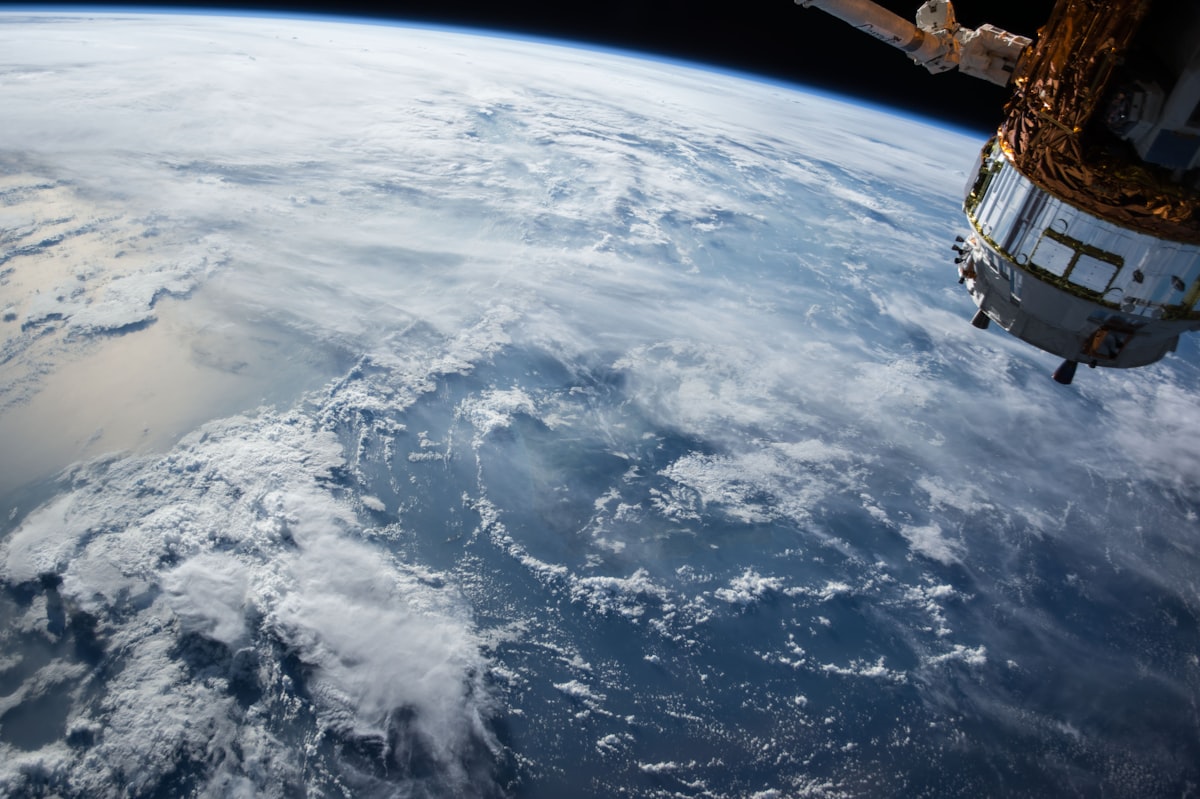
From GPS navigation and weather forecasting to global satellite broadband and military reconnaissance, modern human civilization depends on a silent flotilla of over 9,000 active satellites circling above our heads. Yet, a widespread misconception persists that satellites stay in space because “there is no gravity up there.” In reality, gravity in Low Earth Orbit is nearly as strong as it is on the ground.
At the International Space Station’s cruising altitude of 400 kilometers (250 miles), Earth’s gravitational pull is approximately **90% as strong as it is at sea level**. If you built a stationary 400-kilometer tower and stepped off the top, you would plummet straight back to Earth like a stone. Why, then, do astronauts float weightlessly and satellites circle indefinitely without falling?
Newton’s Cannonball: The Intuitive Secret of Orbit
In 1687, Sir Isaac Newton explained orbital motion in his *Philosophiae Naturalis Principia Mathematica* through a famous thought experiment: **Newton’s Cannon**.
Imagine placing a powerful cannon atop an impossibly high mountain peak above Earth’s atmosphere.
- Fire a cannonball with modest gunpowder: it travels a few kilometers downrange before gravity pulls it down to strike the ground.
- Add more gunpowder: the cannonball travels further, curving downward as Earth’s surface curves away beneath it.
- Fire it at precisely **7.8 kilometers per second (17,500 mph)**: the cannonball falls toward Earth, but the spherical surface of Earth curves away beneath it at the exact identical rate! The cannonball falls continuously *around* the curve of the planet, never hitting the ground.
An orbit is not a place free from gravity; it is a state of perpetual free-fall at high horizontal velocity. Astronauts float not because there is no gravity, but because their spacecraft and their bodies are falling together toward the planet at identical acceleration.
The Three Major Orbital Regimes
1. Low Earth Orbit (LEO)
Altitude: 160 – 2,000 km | Speed: ~7.8 km/s
Orbital period is roughly 90 minutes. Home to the ISS, Hubble Space Telescope, and megaconstellations like SpaceX Starlink.
2. Medium Earth Orbit (MEO)
Altitude: 2,000 – 35,786 km | Speed: ~3.9 km/s
Orbital period is roughly 12 hours. The ideal sweet spot for global satellite positioning constellations (GPS, Galileo, GLONASS).
3. Geostationary Orbit (GEO)
Altitude: Exactly 35,786 km | Speed: 3.07 km/s
Orbital period matches Earth’s rotation (23h 56m 4s). Satellites appear motionless in the sky, enabling fixed satellite TV dishes.
Orbital Maneuvers: The Hohmann Transfer & Stationkeeping
Once a satellite is established in orbit, changing its altitude, inclination, or position requires precise application of orbital mechanics governed by the vis-viva equation ($v^2 = GM(2/r – 1/a)$).
The Science of In-Space Propulsion and Orbital Transfers:
- The Hohmann Transfer Orbit: Engineered by German engineer Walter Hohmann in 1925, this is the most fuel-efficient two-burn maneuver to transfer a spacecraft between two circular orbits of different altitudes. The first rocket burn at perigee boosts the satellite into an elliptical transfer orbit whose apogee matches the target altitude. Upon arriving at apogee, a second burn circularizes the orbit.
- Ion and Hall-Effect Thrusters: While chemical rockets produce immense thrust for short periods, modern satellites (such as Starlink) utilize electric ion propulsion. By using electrical power from solar panels to ionize noble gases (krypton or xenon) and accelerating ions through an electrostatic grid at 30,000 m/s, ion thrusters achieve ultra-high specific impulse ($I_{sp} > 3,000 ext{ seconds}$), providing continuous, gentle stationkeeping for years on tiny quantities of propellant.
- Orbital Perturbations: Earth is not a perfect sphere; its equatorial bulge (the $J_2$ gravitational perturbation) exerts an uneven torque that causes a satellite’s orbital plane to precess over time. Astrodynamicists cleverly exploit this precession to design Sun-Synchronous Orbits (SSO), where the orbital plane rotates at exactly 360 degrees per year, keeping the satellite in permanent sunlight.
- Automated Collision Avoidance: With thousands of active satellites in Low Earth Orbit, flight control centers run automated conjunction assessment algorithms. If two satellites are predicted to pass within 500 meters of each other, onboard autonomous thrusters execute small avoidance burns to eliminate collision risks.
Orbital mechanics is the invisible celestial choreography enabling our interconnected technological world, turning Newtonian gravitational physics into daily global infrastructure.
Why Atmospheric Drag Causes Orbital Decay
While space is called a vacuum, Earth’s upper thermosphere and exosphere extend hundreds of kilometers above the surface. In Low Earth Orbit, satellites continuously collide with sparse atmospheric gas particles.
This friction gradually robs the spacecraft of kinetic energy. As a satellite slows, gravity pulls it into lower, denser layers of atmosphere, accelerating orbital decay until it plunges into the mesosphere, burning up as a brilliant fireball. To prevent decay, the International Space Station uses periodic rocket burns from attached cargo freighters (like Progress or Cygnus) to boost its altitude by several kilometers every few months.
| Orbital Type | Standard Altitude | Orbital Period | Primary Use Case |
|---|---|---|---|
| Low Earth Orbit (LEO) | 400 – 600 km | 92 Minutes | Human spaceflight, high-res Earth imaging, low-latency internet |
| Sun-Synchronous (SSO) | 600 – 800 km (Polar) | 98 Minutes | Consistent solar lighting for climate and weather reconnaissance |
| Semi-Synchronous (MEO) | 20,200 km | 12 Hours | Atomic clock satellite navigation (GPS constellation) |
| Geostationary (GEO) | 35,786 km | 23h 56m 4s | Full-disk weather monitoring (GOES) & direct-to-home broadcast TV |
Frequently Asked Questions
What is orbital escape velocity?
To enter orbit around Earth, a rocket must accelerate to orbital velocity (~7.8 km/s). To break free from Earth’s gravity well entirely and journey to the Moon or Mars, it must accelerate to escape velocity: approximately **11.2 kilometers per second (25,000 mph)**.
What happens to dead satellites in Geostationary Orbit?
Because GEO is too high for atmospheric drag to deorbit satellites, operators use the final dregs of onboard fuel to boost retiring satellites 300 kilometers higher into an official “Graveyard Orbit,” preserving the prime orbital belt for future active satellites.
What is the Kessler Syndrome?
Proposed by NASA scientist Donald Kessler in 1978, it is a theoretical scenario where space debris density in LEO reaches a tipping point: collisions between satellites create clouds of shrapnel, triggering a cascading chain reaction that renders orbital space unusable for generations.
Orbital Maneuvers: The Hohmann Transfer & Stationkeeping
Once a satellite is established in orbit, changing its altitude, inclination, or position requires precise application of orbital mechanics governed by the vis-viva equation ($v^2 = GM(2/r – 1/a)$).
The Science of In-Space Propulsion and Orbital Transfers:
- The Hohmann Transfer Orbit: Engineered by German engineer Walter Hohmann in 1925, this is the most fuel-efficient two-burn maneuver to transfer a spacecraft between two circular orbits of different altitudes. The first rocket burn at perigee boosts the satellite into an elliptical transfer orbit whose apogee matches the target altitude. Upon arriving at apogee, a second burn circularizes the orbit.
- Ion and Hall-Effect Thrusters: While chemical rockets produce immense thrust for short periods, modern satellites (such as Starlink) utilize electric ion propulsion. By using electrical power from solar panels to ionize noble gases (krypton or xenon) and accelerating ions through an electrostatic grid at 30,000 m/s, ion thrusters achieve ultra-high specific impulse ($I_{sp} > 3,000 ext{ seconds}$), providing continuous, gentle stationkeeping for years on tiny quantities of propellant.
- Orbital Perturbations: Earth is not a perfect sphere; its equatorial bulge (the $J_2$ gravitational perturbation) exerts an uneven torque that causes a satellite’s orbital plane to precess over time. Astrodynamicists cleverly exploit this precession to design Sun-Synchronous Orbits (SSO), where the orbital plane rotates at exactly 360 degrees per year, keeping the satellite in permanent sunlight.
- Automated Collision Avoidance: With thousands of active satellites in Low Earth Orbit, flight control centers run automated conjunction assessment algorithms. If two satellites are predicted to pass within 500 meters of each other, onboard autonomous thrusters execute small avoidance burns to eliminate collision risks.
Orbital mechanics is the invisible celestial choreography enabling our interconnected technological world, turning Newtonian gravitational physics into daily global infrastructure.
Orbital Maneuvers: The Hohmann Transfer & Stationkeeping
Once a satellite is established in orbit, changing its altitude, inclination, or position requires precise application of orbital mechanics governed by the vis-viva equation ($v^2 = GM(2/r – 1/a)$).
The Science of In-Space Propulsion and Orbital Transfers:
- The Hohmann Transfer Orbit: Engineered by German engineer Walter Hohmann in 1925, this is the most fuel-efficient two-burn maneuver to transfer a spacecraft between two circular orbits of different altitudes. The first rocket burn at perigee boosts the satellite into an elliptical transfer orbit whose apogee matches the target altitude. Upon arriving at apogee, a second burn circularizes the orbit.
- Ion and Hall-Effect Thrusters: While chemical rockets produce immense thrust for short periods, modern satellites (such as Starlink) utilize electric ion propulsion. By using electrical power from solar panels to ionize noble gases (krypton or xenon) and accelerating ions through an electrostatic grid at 30,000 m/s, ion thrusters achieve ultra-high specific impulse ($I_{sp} > 3,000 ext{ seconds}$), providing continuous, gentle stationkeeping for years on tiny quantities of propellant.
- Orbital Perturbations: Earth is not a perfect sphere; its equatorial bulge (the $J_2$ gravitational perturbation) exerts an uneven torque that causes a satellite’s orbital plane to precess over time. Astrodynamicists cleverly exploit this precession to design Sun-Synchronous Orbits (SSO), where the orbital plane rotates at exactly 360 degrees per year, keeping the satellite in permanent sunlight.
- Automated Collision Avoidance: With thousands of active satellites in Low Earth Orbit, flight control centers run automated conjunction assessment algorithms. If two satellites are predicted to pass within 500 meters of each other, onboard autonomous thrusters execute small avoidance burns to eliminate collision risks.
Orbital mechanics is the invisible celestial choreography enabling our interconnected technological world, turning Newtonian gravitational physics into daily global infrastructure.