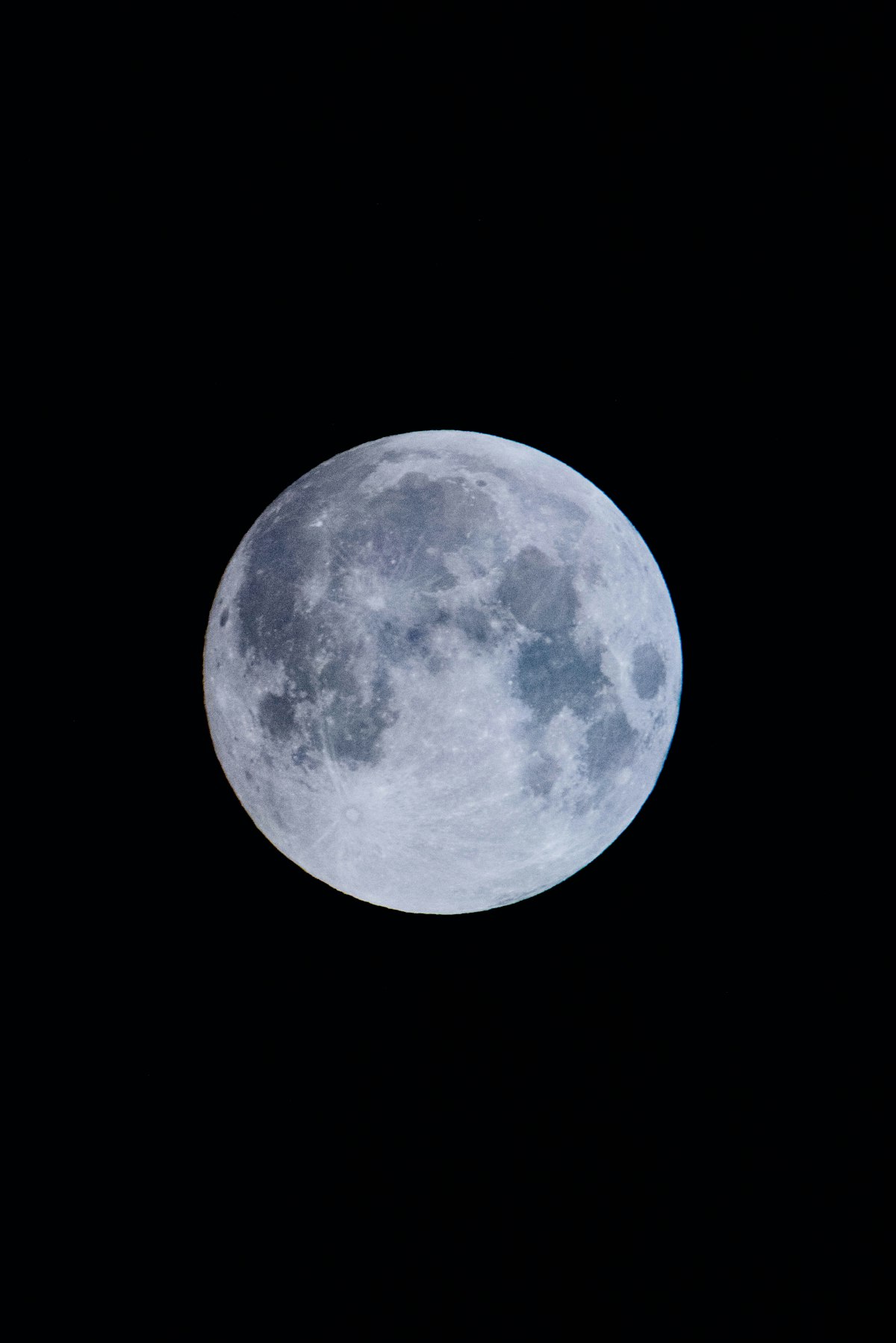
Orbiting an average of 384,400 kilometers away, the Moon is Earth’s only natural satellite and the most detailed astronomical object accessible to amateur observers. Even the smallest pair of birdwatching binoculars or a 60mm department store refractor reveals a rugged alien landscape sculpted by four billion years of violent meteorite bombardments and ancient volcanic basalt floods.
However, many beginners make one fundamental mistake: they wait for the Full Moon to pull out their telescope. Counterintuitively, the **Full Moon is the worst time to observe lunar topography**. During Full Moon, sunlight strikes the lunar surface from directly overhead, casting zero shadows. The surface appears flat, bleached, and blindingly bright.
The finest topographic views are always found along the Terminator—the dividing line between lunar day and lunar night. Along the terminator, the Sun is just rising or setting on the Moon. Mountains, crater rims, and central peaks cast long, dramatic, pitch-black shadows across valleys, revealing subtle elevation variations in three-dimensional relief.
The Two Geological Faces of the Moon
Lunar Maria (The Seas)
Dark, smooth basaltic plains formed 3.1 to 3.8 billion years ago when massive asteroid impacts cracked the lunar crust, allowing molten magma to flood lowlands (e.g., Mare Tranquillitatis).
Lunar Terrae (The Highlands)
Bright, heavily cratered mountainous terrain composed of anorthosite rock. These ancient highlands represent the primordial crust of the Moon, dating back 4.4 billion years.
Lunar Libration & The Exploration of the Limb Zones
Because the Moon is tidally locked to Earth, completing one rotation on its axis in the exact same time it takes to complete one orbit around Earth (27.3 days), it presents the same familiar face toward our planet at all times. However, keen observers notice a fascinating wobble known as **Lunar Libration**.
How Libration Unveils 59% of the Lunar Surface:
- Libration in Longitude (East-West Wobble): The Moon’s orbital velocity varies along its elliptical orbit (moving faster at perigee and slower at apogee in accordance with Kepler’s second law), while its axial rotation rate remains constant. This mismatch creates an apparent east-west nodding motion, allowing observers on Earth to peek around the eastern and western limbs.
- Libration in Latitude (North-South Tilt): The Moon’s rotational axis is tilted 6.7 degrees relative to its orbital plane. Over the course of a monthly orbit, Earth observers can alternately see 6.7 degrees past the lunar North Pole and 6.7 degrees past the South Pole.
- Observing Mare Orientale During Favorable Libration: Mare Orientale is the youngest, best-preserved multi-ring impact basin on the Moon—a colossal bullseye measuring 900 kilometers across surrounded by three concentric mountain rings. Located on the extreme southwestern limb, it is normally invisible from Earth, but during peak favorable libration, its outer mountain ring (Montes Cordillera) tilts into dramatic profile view.
- High-Resolution Lunar Sketching & Shadow Timing: Tracking crater shadow progression over 3-to-4-hour observing sessions reveals minute topographic details: tiny central crater pits, volcanic domes with caldera vents (such as the Marius Hills), and delicate graben faults that appear for only a few hours before washing out under midday sunlight.
Exploring the Moon is an ever-changing celestial journey: as sunlight angles shift across the lunar month, familiar landscapes transform continuously into new, dramatic geological vistas.
Five Must-See Lunar Targets for Every Stargazer
1. Crater Tycho and Its Spectacular Ray System
Located in the southern highlands, Tycho is an 85-kilometer-wide impact crater formed only 108 million years ago (during the age of Earth’s dinosaurs). Because it is geologically young, its impact ejecta has not been darkened by space weathering. During Full Moon, Tycho’s brilliant white ejecta rays stretch across more than 1,500 kilometers of the lunar disc like spokes on a giant bicycle wheel.
2. Crater Copernicus: The Monarch of the Moon
Best observed around Day 9 or 10 of the lunar cycle (waxing gibbous), Copernicus spans 93 kilometers across Oceanus Procellarum. Its terraced rim walls plunge nearly 4,000 meters down to a flat floor adorned with multiple towering central mountain peaks created by the rebounding shockwave of the ancient meteorite impact.
3. The Apennine Mountains (Montes Apenninus)
Rising along the southeastern edge of Mare Imbrium, the Apennines form the most majestic mountain range on the Moon, spanning over 600 kilometers with peaks soaring to 5,000 meters (comparable to the Swiss Alps). Near the base of this range lies Hadley Rille, visited by Apollo 15 astronauts in 1971.
4. Vallis Alpes (The Alpine Valley)
A dramatic 166-kilometer-long geological rift valley cutting straight through the lunar Alps. At high magnification in an 8-inch telescope during steady atmospheric seeing, you can spot a tiny meandering rille running down the exact center of the valley floor.
5. Rupes Recta (The Straight Wall)
Located in Mare Nubium, Rupes Recta is a prominent lunar fault line measuring 110 kilometers long. When the morning terminator passes over it around Day 8, the fault’s 300-meter escarpment casts an inky black line across the plain, resembling an immense artificial wall.
| Lunar Phase | Age in Days | Key Features on the Terminator | Recommended Eyepiece / Filter |
|---|---|---|---|
| Waxing Crescent | Day 3 – 5 | Mare Crisium, Crater Petavius with floor rilles | Low power wide-field; enjoy earthshine |
| First Quarter | Day 7 | Mare Serenitatis, Crater Albategnius, Rupes Recta | Medium-high magnification (100x – 150x) |
| Waxing Gibbous | Day 9 – 11 | Crater Copernicus, Crater Plato, Sinus Iridum | Neutral Density or Polarizing Lunar Filter |
| Full Moon | Day 14 – 15 | Tycho and Copernicus bright ray systems; albedo contrast | Variable Polarizer (Essential to cut glare) |
Frequently Asked Questions
Can looking at the Moon through a telescope damage my eyes?
No. Unlike the Sun, the Moon only reflects sunlight and does not emit harmful ultraviolet or infrared radiation. However, in a 6-inch or larger telescope, a bright Moon will saturate your eye’s dark adaptation and cause brief afterimages. Using a neutral-density Moon filter makes viewing comfortable.
What is “Earthshine” or “the old Moon in the new Moon’s arms”?
During a thin crescent phase, the unlit dark portion of the Moon faintly glows. This occurs because Earth’s clouds and oceans reflect sunlight into space, softly illuminating the lunar nightside.
Why do craters have central peaks?
When a massive meteorite strikes at hypersonic velocity, rock behaves like a liquid under extreme pressure. The crater floor compresses violently and rebounds upward in the center—forming central mountain peaks—just like a drop of water splashing upward after hitting a pool.
Lunar Libration & The Exploration of the Limb Zones
Because the Moon is tidally locked to Earth, completing one rotation on its axis in the exact same time it takes to complete one orbit around Earth (27.3 days), it presents the same familiar face toward our planet at all times. However, keen observers notice a fascinating wobble known as **Lunar Libration**.
How Libration Unveils 59% of the Lunar Surface:
- Libration in Longitude (East-West Wobble): The Moon’s orbital velocity varies along its elliptical orbit (moving faster at perigee and slower at apogee in accordance with Kepler’s second law), while its axial rotation rate remains constant. This mismatch creates an apparent east-west nodding motion, allowing observers on Earth to peek around the eastern and western limbs.
- Libration in Latitude (North-South Tilt): The Moon’s rotational axis is tilted 6.7 degrees relative to its orbital plane. Over the course of a monthly orbit, Earth observers can alternately see 6.7 degrees past the lunar North Pole and 6.7 degrees past the South Pole.
- Observing Mare Orientale During Favorable Libration: Mare Orientale is the youngest, best-preserved multi-ring impact basin on the Moon—a colossal bullseye measuring 900 kilometers across surrounded by three concentric mountain rings. Located on the extreme southwestern limb, it is normally invisible from Earth, but during peak favorable libration, its outer mountain ring (Montes Cordillera) tilts into dramatic profile view.
- High-Resolution Lunar Sketching & Shadow Timing: Tracking crater shadow progression over 3-to-4-hour observing sessions reveals minute topographic details: tiny central crater pits, volcanic domes with caldera vents (such as the Marius Hills), and delicate graben faults that appear for only a few hours before washing out under midday sunlight.
Exploring the Moon is an ever-changing celestial journey: as sunlight angles shift across the lunar month, familiar landscapes transform continuously into new, dramatic geological vistas.
Lunar Libration & The Exploration of the Limb Zones
Because the Moon is tidally locked to Earth, completing one rotation on its axis in the exact same time it takes to complete one orbit around Earth (27.3 days), it presents the same familiar face toward our planet at all times. However, keen observers notice a fascinating wobble known as **Lunar Libration**.
How Libration Unveils 59% of the Lunar Surface:
- Libration in Longitude (East-West Wobble): The Moon’s orbital velocity varies along its elliptical orbit (moving faster at perigee and slower at apogee in accordance with Kepler’s second law), while its axial rotation rate remains constant. This mismatch creates an apparent east-west nodding motion, allowing observers on Earth to peek around the eastern and western limbs.
- Libration in Latitude (North-South Tilt): The Moon’s rotational axis is tilted 6.7 degrees relative to its orbital plane. Over the course of a monthly orbit, Earth observers can alternately see 6.7 degrees past the lunar North Pole and 6.7 degrees past the South Pole.
- Observing Mare Orientale During Favorable Libration: Mare Orientale is the youngest, best-preserved multi-ring impact basin on the Moon—a colossal bullseye measuring 900 kilometers across surrounded by three concentric mountain rings. Located on the extreme southwestern limb, it is normally invisible from Earth, but during peak favorable libration, its outer mountain ring (Montes Cordillera) tilts into dramatic profile view.
- High-Resolution Lunar Sketching & Shadow Timing: Tracking crater shadow progression over 3-to-4-hour observing sessions reveals minute topographic details: tiny central crater pits, volcanic domes with caldera vents (such as the Marius Hills), and delicate graben faults that appear for only a few hours before washing out under midday sunlight.
Exploring the Moon is an ever-changing celestial journey: as sunlight angles shift across the lunar month, familiar landscapes transform continuously into new, dramatic geological vistas.